
Local Keyword Research for Smoke and Vape Shops
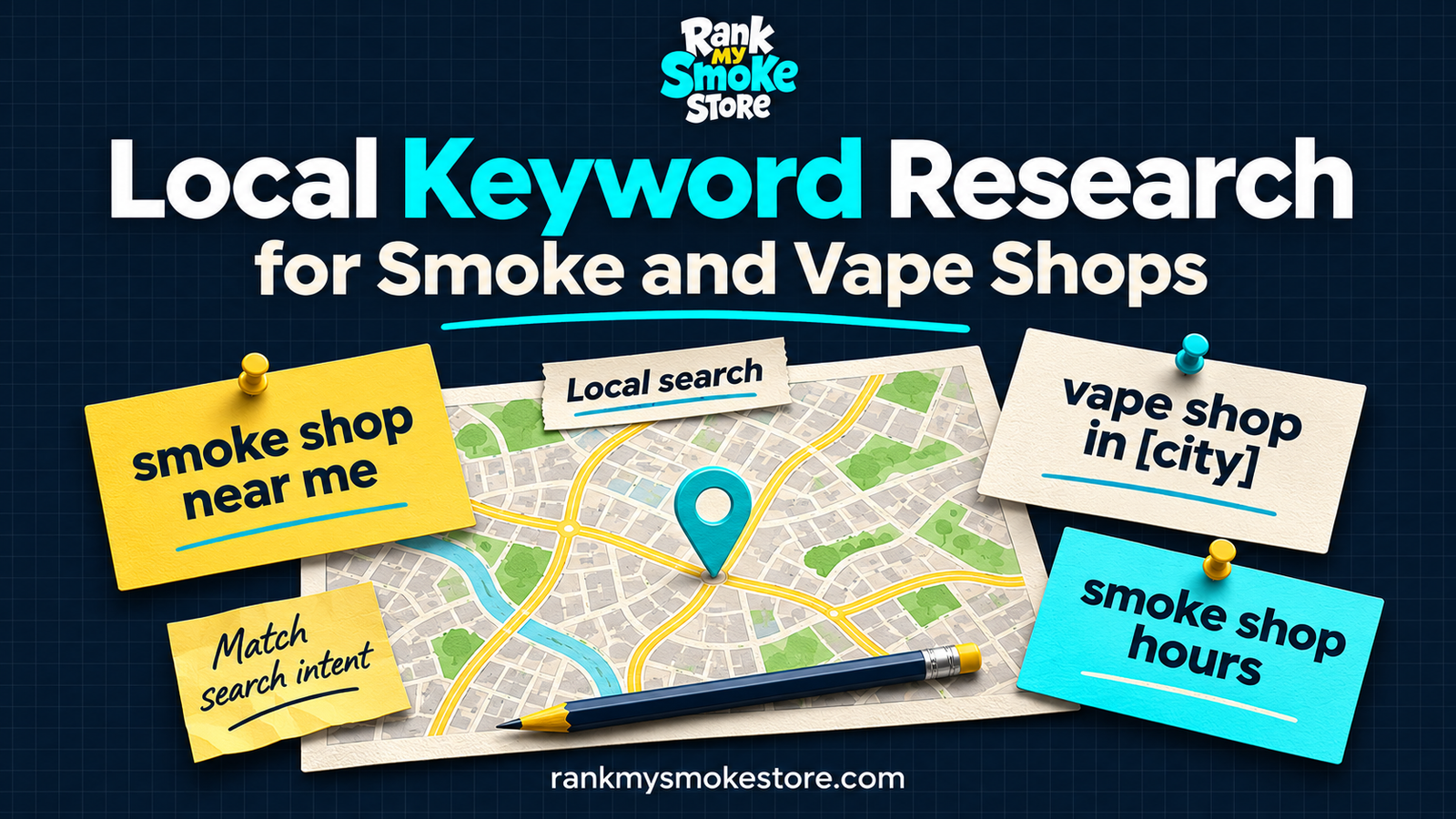
A list of popular keywords is not a content strategy.
Some searches come from nearby shoppers. Others come from business owners, job applicants or people looking for information unrelated to your store. Targeting all of them can attract attention without attracting the right audience.
Local keyword research helps you identify what people need and decide which page should answer that need.
Separate Customer Searches From Business Searches
The audience determines the keyword.
For example, “smoke shop in [city]” usually suggests a shopper looking for a location. “Smoke shop website design” suggests a business owner looking for a service provider.
A retailer and a marketing agency should not build identical keyword plans simply because both work in the same industry.
Start by writing down who should visit the page and what useful action they should be able to take afterward.
Collect Search Terms From Your Existing Business
Begin with information you already have:
Questions staff regularly answer.
Search Console queries.
Website search terms, if available.
Questions submitted through contact forms.
Language customers use when describing the store.
Then group the terms by need.
Search intent
Example
Suitable destination
Find a store
“smoke shop in [city]”
- Real location page
- Find business information
“[store name] hours”
- Location or contact page
- Understand the business
“[store name] reviews”
- Accurate business and reputation information
- Research a topic
- A recurring customer question
- Helpful article or FAQ
These examples illustrate intent; they are not verified search-volume recommendations.
Match Each Important Topic to a Page
Create a simple keyword map with four columns: topic, intended reader, target page and next action.
If two pages answer the same question, assess whether they should be combined or clearly differentiated.
For example, a homepage can introduce the business while a location page provides detailed information about one branch. Repeating the same paragraphs on both pages offers little additional value.
Our smoke shop SEO guide explains how keyword decisions fit the wider website strategy.
Use Search Results to Check Intent
Before writing, search the phrase and inspect the kinds of results that appear.
Are people being shown local listings, store pages, tutorials or service providers? This is a useful clue about what a search engine interprets the query to mean.
Record the observation without assuming every searcher sees the same results. Location and context can affect what appears.
A keyword may be relevant to your industry while still being wrong for the page you planned.
Place Keywords Where They Help Readers
Use a clear topic in the page title, main heading, introductory text and relevant sections.
Write naturally. A location page does not need “smoke shop near me” in every paragraph.
Google’s Search Essentials recommends using words people would search for in prominent, descriptive places such as titles, headings and link text. developers.google.com
A descriptive link such as how to measure smoke shop SEO results also tells readers what they will find.
Review the Keyword Map After Publication
Use actual impressions, clicks and inquiries to evaluate the plan. A keyword list should evolve as you learn which searches fit the business.
Start with a small number of useful pages rather than a large number of near-duplicates. For help connecting research to implementation, explore Rank My Smoke Store’s services.