
What Local SEO Includes for a Smoke Shop
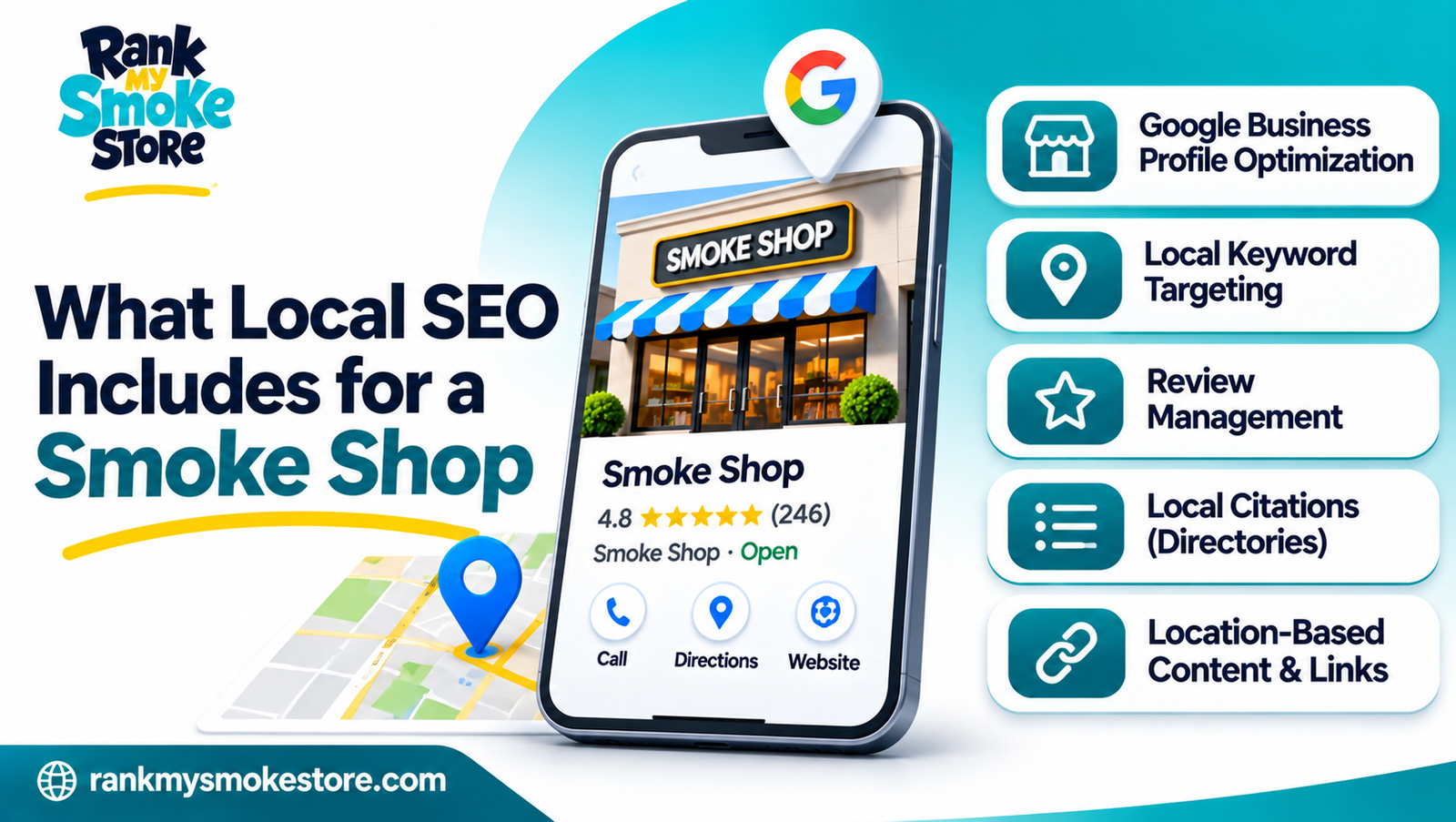
Local SEO for a smoke shop is the work of making the business easier to understand and discover through relevant local searches. It connects the website, business information, location pages and measurement process. It is not a single setting that can be switched on and forgotten.
Owners often receive proposals containing broad labels such as on-page optimization, citations and content. Those labels are only useful when the provider explains what will change, why it matters and how completion will be verified. A clear scope lets you compare services without assuming every package includes the same work.
This guide explains the main components and gives you a way to decide which ones your business needs first.
Business Information and Account Control
Start with the facts that identify the store. Confirm the approved name, address, telephone number, opening hours and website destination for each location. Resolve contradictions before distributing the information across more platforms.
Create a simple business record with an owner for updates. If the manager changes the closing time, the person responsible for the website and profile needs to know. Otherwise, different channels can continue displaying different versions of the same fact.
Account control belongs in this initial work. Identify who owns the domain, hosting, analytics and Business Profile. An agency can help manage these assets, but the store should understand who has access and how that access can be changed.
Google Business Profile Work
A profile project can include reviewing the business identity, relevant categories, hours, contact details, photographs and website destination. It may also involve identifying ownership or verification issues that need to be resolved through the platform.
Google explains that local results depend on relevance, distance and prominence in its local ranking guidance. Accurate information is part of the work; controlling the searcher's location is not.
Ask the provider to distinguish a one-time review from ongoing management. Updating the profile once does not include responding to every future change, notification or customer review unless those responsibilities are explicitly covered.
For the implementation sequence, read our Google Business Profile optimization guide.
Website Pages That Match Customer Needs
Local SEO requires pages that provide a useful destination after discovery. For a store, that often means complete location information, clear navigation and reliable contact options.
A single-location homepage may carry much of this information. A business with several branches usually needs a more deliberate structure so visitors can identify the correct store without comparing scattered addresses.
The content should explain actual differences between locations where they matter. Entrance details, parking, hours and photographs can be useful. Repeating the same generic paragraph while changing a city name adds little value for someone planning a visit.
A website review should also ask whether the information is easy to use on a phone. A complete address hidden inside an image may be harder to select or use than ordinary readable text.
Keyword Research and Page Mapping
Keyword research should connect search language with real pages. It starts with the audience, not an enormous spreadsheet of loosely related terms.
For a retailer, relevant queries may involve a store category and location. For an agency serving retailers, useful terms involve services and business problems. Those audiences should not be mixed simply because both use the words smoke shop.
A keyword map records the topic, intended reader, page, next action and supporting content. It helps prevent multiple articles from competing to answer the same question. It also reveals gaps where the website lacks a suitable destination.
Ask which decisions the research will inform. If the answer is only that keywords will be inserted into existing text, the scope may be missing the more important work of matching pages to intent.
Technical Access and Indexing
Technical SEO checks whether important pages can be accessed and interpreted as intended. This can include page responses, indexing instructions, canonical URLs, sitemap output, internal links and JavaScript rendering.
For example, a sitemap address that displays the homepage is a server-routing problem, not a writing problem. An article with useful information cannot fix that behavior by repeating a keyword more often.
The scope should distinguish finding issues from implementing repairs. An audit report may identify a broken route, but development time to fix it may be a separate service. Confirm who will do the work and what evidence will show that the fix is complete.
Use our smoke shop SEO audit guide to understand the findings you should expect.
Reviews and Reputation Processes
Review management can include helping the business request honest feedback, monitor responses and address recurring concerns. It should connect public communication with the actual customer experience.
A useful process might identify the correct review destination for each branch, assign someone to respond and record issues that require operational attention. If customers repeatedly mention incorrect hours, the task is to correct the hours, not merely write a more polished response.
Ask what the agency requires from your staff. A review program that depends on actions no one has time to perform is unlikely to operate consistently. Keep responsibilities clear and proportionate to the team's capacity.
Any workflow must follow the platform's current review policies. Avoid promises to remove legitimate criticism or manufacture a preferred rating.
Business Listings and Local References
Business listings should help people find accurate information about a real location. Review important existing profiles before buying a large quantity of new submissions.
A useful listing task identifies the platform, current information, required correction and access status. It also records whether a change is complete, pending or impossible without action from the owner.
Treat relevance and accuracy as the purpose. A report counting hundreds of submissions is not enough to show that those entries are useful, maintained or appropriate for the business.
Local references can also come from genuine relationships, such as a business association or a factual feature about the company. Do not invent partnerships or pay for links solely to manipulate ranking.
Measurement and Reporting
An SEO plan should define the measurements before work begins. Record the available baseline, reporting period and known gaps in the data.
Useful reporting can include search visibility for relevant topics, traffic to important pages and successful website actions. It should explain whether a reported action is a click, a submitted inquiry or an outcome confirmed by the team.
A telephone button click is not a completed sale. A form submission can be spam or outside the business's scope. Keeping those distinctions visible makes the report more useful for decisions about investment.
Our SEO reporting handbook explains how to connect activity to outcomes without overstating attribution.
What Is Not Automatically Included
A local SEO agreement does not automatically include a new website, unlimited articles, paid advertising, daily social posts, hosting or software subscriptions. Those may be available, but they need their own defined scope.
Likewise, SEO work cannot guarantee platform approval, a particular position for every searcher or a fixed number of customers. The business's location, competition, website condition and operating decisions all affect what is realistic.
Ask for exclusions in ordinary language. It is better to know before signing that a redesign is separate than to discover it after an audit identifies a structural problem.
Choose the Right Starting Scope
Imagine a store with accurate profile information but a broken mobile contact form. The first priority is likely the failed inquiry journey. Another store may have a usable website but outdated branch information across important destinations. Its initial work should look different.
These are illustrative situations, not client results. Their purpose is to show why a useful recommendation begins with evidence rather than assigning every business the same package.
Ask the provider to identify the first three priorities, the expected deliverables and the access required. Review the completed work before expanding into additional content or channels.
Rank My Smoke Store offers services that can be scoped around website, profile and local search needs. Begin with the condition of your existing setup, agree on what needs to change and use documented progress to guide the next phase.